r-Tms (Repetitive Transcranial Magnetic Stimulation) in the treatment of tinnitus

Modern Approaches to Tinnitus Treatment: Repetitive Transcranial Magnetic Stimulation (rTMS)
Understanding Tinnitus Beyond the Ear
Tinnitus is the perception of sound in the absence of an external acoustic source. It is commonly described as ringing in the ears but may also be perceived as buzzing, humming, hissing, clicking, or pulsatile sounds.
Although tinnitus often begins within the auditory system, current research shows that it is not solely an ear disorder. Persistent tinnitus may involve complex interactions between the inner ear, auditory nerve, brainstem, auditory cortex, and the brain networks responsible for attention, memory, emotion, and sound perception.
For this reason, modern tinnitus care focuses on understanding the biological mechanisms responsible for tinnitus rather than simply attempting to suppress the symptom.
Why a Comprehensive Evaluation Matters
Tinnitus is a symptom, not a disease.
The same complaint may arise from many different underlying conditions. Therefore, identifying the contributing factors is essential before treatment planning.
Every patient undergoes a comprehensive Otorhinolaryngology (ENT) evaluation at our clinic. When clinically indicated, consultations with other medical specialties may be requested to investigate associated medical conditions.
Rather than applying the same treatment to every patient, we believe that successful tinnitus management begins with understanding the individual patient.
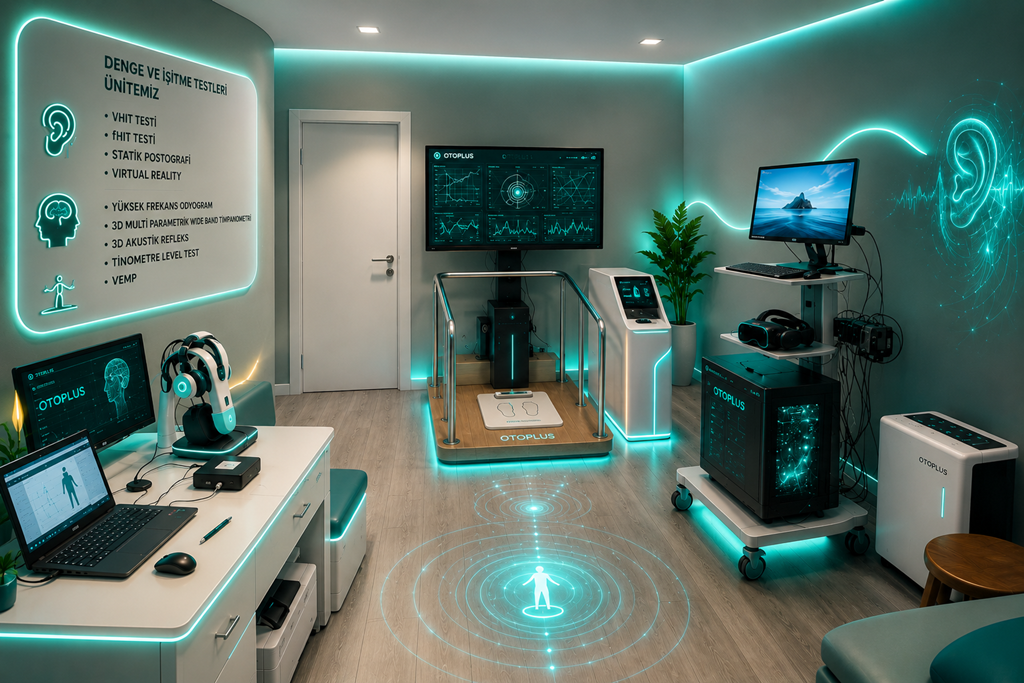
Advanced Diagnostic Technologies
Depending on the patient's clinical presentation, the diagnostic evaluation may include:
- Comprehensive ENT examination
- Pure-tone and Speech Audiometry
- High-Frequency Audiometry
- Three-Dimensional Wideband Tympanometry
- Acoustic Reflex Testing
- Eustachian Tube Function Testing
- Tinnitus Psychoacoustic Measurements (Tinnitometry)
- Vestibular Evaluation
- Magnetic Resonance Imaging (MRI)
- Functional Magnetic Resonance Imaging (fMRI), when clinically indicated
These examinations help identify possible peripheral, central, functional, and neurophysiological mechanisms contributing to tinnitus.
.jpg) Understanding the Auditory Pathways
Understanding the Auditory Pathways
Modern neuroscience has significantly changed our understanding of tinnitus.
Instead of viewing tinnitus as a disorder confined to the inner ear, current evidence suggests that abnormal activity may develop throughout the auditory pathway.
This complex network includes:
- Cochlea
- Hair Cells
- Spiral Ganglion
- Auditory Nerve
- Brainstem Auditory Nuclei
- Thalamus
- Primary Auditory Cortex
- Auditory Association Cortex
- Limbic System
- Frontal Cortical Networks
These structures continuously communicate with one another. Dysfunction at one or multiple levels may contribute to the perception and persistence of tinnitus.
Understanding which parts of this network are involved helps guide individualized treatment planning.
Repetitive Transcranial Magnetic Stimulation (rTMS)
Repetitive Transcranial Magnetic Stimulation (rTMS) is a non-invasive neuromodulation technique that delivers controlled magnetic pulses to specific regions of the brain.
Initially introduced in neurology and psychiatry, rTMS has become one of the most actively investigated treatment modalities for chronic tinnitus.
Its objective is not to eliminate tinnitus directly but to modulate abnormal neural activity associated with tinnitus perception.
Today, numerous clinical studies continue to evaluate the role of rTMS as part of a comprehensive tinnitus management strategy.
How Does rTMS Work?
The exact biological mechanisms are still being investigated.
Current evidence suggests that rTMS may influence tinnitus through several complementary mechanisms, including:
- Modulation of cortical excitability
- Reduction of abnormal neuronal synchronization
- Functional reorganization of auditory networks
- Regulation of neural connectivity
- Promotion of adaptive neuroplasticity
Neuroplasticity refers to the brain's ability to reorganize and strengthen functional neural connections throughout life.
Rather than acting on the ear itself, rTMS aims to influence the brain networks involved in tinnitus perception.
 Personalized Treatment Planning
No single treatment protocol is appropriate for every patient.
Tinnitus varies considerably in its causes, clinical presentation, duration, associated hearing loss, vestibular involvement, and psychological impact.
For this reason, treatment parameters should be individualized whenever possible.
Depending on the patient's findings, treatment planning may consider:
- Duration of tinnitus
- Hearing status
- Audiological findings
- Vestibular findings
- Functional imaging findings
- Associated medical conditions
- Individual clinical characteristics
Our goal is to develop a treatment strategy that reflects the patient's unique clinical profile rather than applying a standardized protocol.
Vestibular Assessment
Some patients experience tinnitus together with dizziness, imbalance, or vertigo.
When clinically indicated, vestibular evaluation may include:
- Video Head Impulse Test (vHIT)
- Functional Head Impulse Test (fHIT)
- Static Posturography
- Virtual Reality–Based Vestibular Assessment
These investigations help determine whether vestibular dysfunction contributes to the patient's symptoms and assist in treatment planning.
What Results Can Patients Expect?
At present, no treatment can completely eliminate tinnitus in every patient.
Clinical outcomes vary according to many factors, including:
- Underlying cause
- Duration of symptoms
- Hearing status
- Patient selection
- Associated medical conditions
- Individual biological variability
Current scientific evidence suggests that selected patients may experience meaningful improvements in tinnitus severity and quality of life when individualized treatment strategies are applied.
Setting realistic expectations and establishing an accurate diagnosis remain essential components of successful tinnitus management.
Our Clinical Philosophy
We believe that tinnitus should not be approached as a single disease with a single treatment.
Instead, every patient deserves a careful diagnostic evaluation aimed at identifying the biological mechanisms responsible for the symptom.
By combining advanced diagnostic technologies, detailed audiological assessment, evidence-informed neuromodulation techniques, and personalized treatment planning, we strive to provide comprehensive, patient-centered tinnitus care based on current scientific knowledge.
Medical Disclaimer
The information provided on this website is for educational purposes only and does not constitute medical advice. Diagnosis and treatment decisions should always be based on an individual medical evaluation by a qualified physician. Treatment outcomes may vary from patient to patient