Dynamic sounds that appear as a crackling, popping, rattling, or noise in the ear

Dynamic Ear Sounds: Clicking, Crackling and Middle Ear Muscle Disorders
Not Every Sound Heard in the Ear Is Tinnitus
Many people occasionally hear clicking, crackling, popping, fluttering, tapping, or rattling sounds in one or both ears. Unlike the continuous ringing typically associated with tinnitus, these dynamic sounds are often intermittent and may occur during swallowing, yawning, chewing, speaking, changes in head position, or alterations in middle-ear pressure.
In most individuals, these sounds are completely normal and represent physiological functions of the auditory system rather than disease. Throughout the day, the Eustachian tube, tympanic membrane, middle-ear ossicles, and middle-ear muscles work continuously to equalize pressure, regulate sound transmission, and protect the delicate structures of the inner ear. As these structures move, subtle sounds may occasionally be perceived, particularly by individuals who are more aware of internal body sounds.
Patients with chronic tinnitus, hyperacusis, anxiety, or increased auditory attention frequently become more sensitive to normal physiological sounds that would otherwise go unnoticed. Increased awareness alone does not necessarily indicate an underlying disorder.
However, when clicking, crackling, fluttering, or rhythmic sounds become persistent, repetitive, occur without an obvious trigger, or are accompanied by hearing loss, dizziness, ear fullness, or pulsatile sensations, further medical evaluation is recommended.
One of the most important challenges in clinical practice is distinguishing harmless physiological sounds from pathological conditions that require medical attention. Careful history taking, detailed otological examination, and appropriate audiological investigations usually allow the underlying mechanism to be identified.
Normal Physiological Dynamic Ear Sounds
The auditory system is remarkably dynamic. Every swallow, every yawn, every movement of the jaw, and every change in atmospheric pressure activates a series of coordinated mechanical events within the middle ear.
Most people have experienced brief clicking or popping sensations while flying, climbing to high altitudes, scuba diving, driving through mountains, or using elevators. Similar sounds may also occur while eating, drinking, chewing, or yawning. These sounds are generally produced by normal pressure equalization within the middle ear and are considered a normal physiological phenomenon.
The principal structure responsible for pressure regulation is the Eustachian tube, which connects the middle ear to the nasopharynx. Normally, the tube remains closed and opens briefly during swallowing, yawning, or chewing. This opening equalizes air pressure across the tympanic membrane, allowing it to vibrate efficiently.
When the Eustachian tube opens, a brief clicking or popping sensation may be perceived. This is simply the sound of pressure equalization and should not be regarded as a disease.
The Middle Ear: An Active Biomechanical System
The middle ear is far more than a passive sound-conducting mechanism. It is an active biomechanical system that amplifies, regulates, and protects sound transmission before acoustic energy reaches the cochlea.
Sound waves striking the tympanic membrane are converted into mechanical vibrations and transmitted through the ossicular chain—the malleus, incus, and stapes. Together, the tympanic membrane and ossicles function as an impedance-matching system between air and the fluid-filled inner ear.
Because the surface area of the tympanic membrane is considerably larger than that of the stapes footplate, sound pressure becomes concentrated as it reaches the oval window. Combined with the lever action of the ossicular chain, this mechanism increases sound pressure by approximately fourteen-fold, enabling efficient transmission of acoustic energy into the cochlea.
Without this sophisticated mechanical system, most sound energy would be reflected at the air-fluid interface of the inner ear, resulting in a marked reduction in hearing sensitivity.
The Acoustic Reflex: The Ear's Natural Protective Mechanism
The middle ear also contains an important protective mechanism known as the acoustic reflex.
The stapedius muscle—the smallest skeletal muscle in the human body—is the principal muscle responsible for this reflex. In most individuals, the reflex begins to develop in response to sound intensities of approximately 70 dB.
Contraction of the stapedius muscle restricts movement of the stapes at the oval window, temporarily reducing the amount of acoustic energy transmitted into the cochlea. This physiological response helps protect the delicate sensory hair cells of the inner ear from excessive acoustic stimulation.
However, the protective capacity of the acoustic reflex is limited. During continuous exposure to loud sounds, the stapedius muscle gradually adapts, and its protective effect diminishes. Consequently, prolonged exposure to sound levels exceeding approximately 90 dB may still damage the cochlea despite activation of the acoustic reflex.
The Tensor Tympani Muscle
The tensor tympani muscle represents the second functional muscle of the middle ear.
Innervated by the mandibular branch of the trigeminal nerve, it participates in regulating middle-ear mechanics during swallowing, chewing, and pressure equalization. Contraction of the tensor tympani increases tension on the tympanic membrane and slightly reduces movement of the ossicular chain.
Although the precise physiological role of this muscle remains incompletely understood, it is believed to contribute to stabilizing the middle ear during self-generated sounds such as chewing and swallowing.
Under normal conditions, neither the stapedius nor the tensor tympani muscle is consciously perceived.
Middle Ear Myoclonus
Occasionally, involuntary contractions of the stapedius muscle, the tensor tympani muscle, or both may occur. This uncommon condition is referred to as Middle Ear Myoclonus.
Patients may describe:
- Clicking
- Crackling
- Fluttering
- Tapping
- Machine-gun–like sounds
- Butterfly-wing fluttering
- Intermittent rhythmic sounds
These contractions may be irregular or rhythmic, short-lasting or prolonged, and may occur spontaneously or be triggered by swallowing, speaking, loud sounds, stress, or facial movements.
Unlike subjective tinnitus, some cases of middle ear myoclonus produce objective tinnitus, meaning that the sound can occasionally be detected by the examiner during otoscopic examination or with specialized recording techniques.
Other Causes of Dynamic Ear Sounds
Not all clicking or crackling sounds originate from the middle-ear muscles.
Other possible causes include:
- Eustachian tube dysfunction
- Upper respiratory tract infections
- Allergic rhinitis
- Middle-ear effusion
- Excessive earwax
- Hair touching the tympanic membrane
- Foreign bodies within the external auditory canal
- Temporomandibular joint disorders (TMJ)
- Bruxism
- Ménière's disease
- Palatal myoclonus
- Vascular abnormalities producing pulsatile tinnitus
Careful clinical evaluation is required to distinguish these conditions.
Diagnosis
Diagnosis begins with a detailed medical history and a comprehensive ENT examination.
Depending on the clinical findings, additional investigations may include:
- Otoscopic examination
- Microscopic ear examination
- Pure-tone audiometry
- High-frequency audiometry
- Tympanometry
- Acoustic reflex testing
- Wideband tympanometry
- Tinnitometry
- Vestibular assessment
- MRI or Functional MRI (when indicated)
The objective is not only to identify the sound itself but also to determine the anatomical structure responsible for generating it.
Treatment
Treatment depends entirely on the underlying cause.
Physiological clicking sounds usually require no treatment and reassurance alone is often sufficient.
When dynamic ear sounds are caused by Eustachian tube dysfunction, allergy, infection, temporomandibular disorders, or other medical conditions, treatment should be directed toward the underlying disorder.
Patients with confirmed middle ear myoclonus may benefit from conservative management, medical therapy, or, in carefully selected cases, surgical intervention. Treatment decisions should always be individualized according to symptom severity, clinical findings, and the underlying pathophysiological mechanism.
Medical Disclaimer
The information provided on this page is intended for educational purposes only and should not replace professional medical evaluation, diagnosis, or treatment. Persistent or bothersome ear sounds should be assessed by a qualified healthcare professional to determine their underlying cause and the most appropriate management
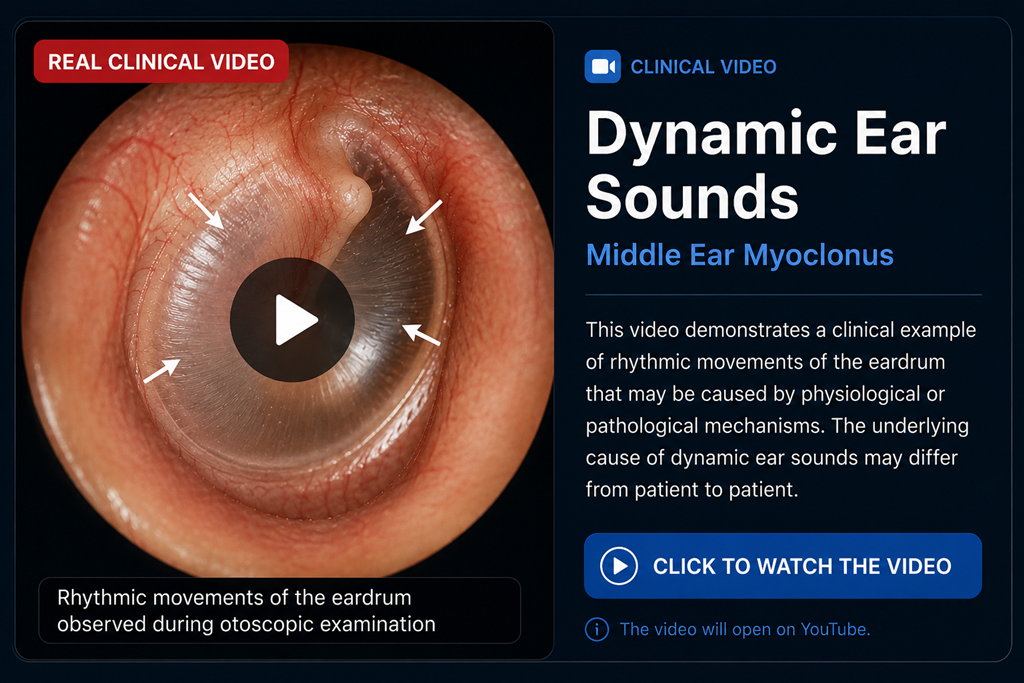
Video :This video illustrates one of the physiological or pathological mechanisms that may be responsible for dynamic ear sounds. The underlying cause may differ among individuals.
Medical Disclaimer
The content on this page is provided for general informational purposes only. It does not replace a professional medical examination, diagnosis, or individualized treatment. The underlying causes of ear sounds can vary considerably between individuals. If your symptoms persist or interfere with your daily life, please seek evaluation by an Ear, Nose and Throat (ENT) specialist.
Scientific References
- Flint PW, Haughey BH, Lund VJ, et al. Cummings Otolaryngology: Head and Neck Surgery. 7th ed. Elsevier; 2021.
- Snow JB, Wackym PA, editors. Ballenger's Otorhinolaryngology: Head and Neck Surgery. 18th ed. People's Medical Publishing House; 2020.
- Merchant SN, Nadol JB Jr. Schuknecht's Pathology of the Ear. 3rd ed. PMPH-USA; 2010.
- Pickles JO. An Introduction to the Physiology of Hearing. 4th ed. Emerald Group Publishing; 2013.
- Katz J, Chasin M, English K, Hood LJ, Tillery KL, editors. Handbook of Clinical Audiology. 7th ed. Wolters Kluwer; 2015.
- Gelfand SA. Essentials of Audiology. 4th ed. Thieme; 2016.
- Guyton AC, Hall JE. Guyton and Hall Textbook of Medical Physiology. 14th ed. Elsevier; 2021.
- Bhimrao SK, Masterson L, Baguley DM. Systematic review of management strategies for middle ear myoclonus. Otolaryngology–Head and Neck Surgery. 2012;146:698-706.
- Ellenstein A, Yusuf N, Hallett M. Middle Ear Myoclonus: Two Informative Cases and a Systematic Discussion of Myogenic Tinnitus. Tremor and Other Hyperkinetic Movements. 2013.
- Swain SK. Middle Ear Myoclonus. BLDE University Journal of Health Sciences. 2022.
- Wong WK, Lee MF. Middle ear myoclonus: Systematic review of results and complications for various treatment approaches. American Journal of Otolaryngology. 2022.
- Zhang-Kraczkowska A, Wong WK. Middle ear myoclonus: Pathophysiology and management. Current Opinion in Otolaryngology & Head and Neck Surgery. 2025.
- Fournier P, et al. Exploring middle ear function in patients with a cluster of symptoms associated with Tonic Tensor Tympani Syndrome (TTTS). 2022.
- Poe DS. Diagnosis and Management of the Patulous Eustachian Tube. Otology & Neurotology. 2007.
- Bance M, Tysome JR, Smith ME. Patulous Eustachian Tube: A Practical Overview. World Journal of Otorhinolaryngology – Head and Neck Surgery. 2019.
- Rosowski JJ, Merchant SN. Mechanical and Acoustic Analysis of Middle Ear Function.
- Hüttenbrink KB. Biomechanics of the Middle Ear. Otolaryngologic Clinics of North America.
- Jerger J. Clinical experience with impedance audiometry.
- Silman S, Gelfand SA. Acoustic reflex measurements in clinical audiology.
- American Academy of Otolaryngology–Head and Neck Surgery (AAO-HNS). Educational resources in Otology and Neurotology